






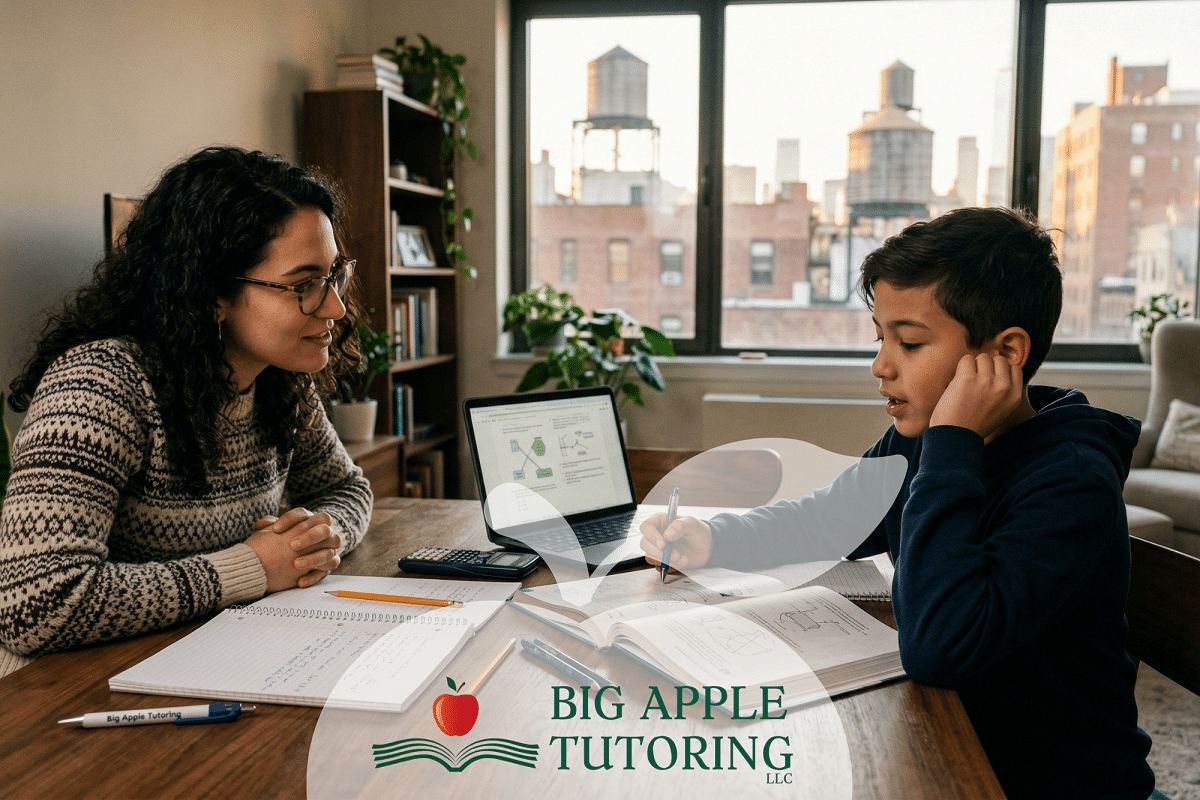
The Homework Problem Most NYC Families Know Too Well
It starts around 4pm in apartments across Manhattan and every borough. A backpack hits the floor, a child announces they have no homework or too much homework, and what follows is a negotiation that drains everyone involved. The work eventually gets done, or it doesn’t, and by the time dinner is on the table, the family has spent two hours in a battle that left nobody feeling good.
This is not a parenting failure. It is a structural reality of how homework functions in New York City schools, and it is something we hear about from virtually every family that comes to us.
At Big Apple Tutoring, we work with students across Manhattan and NYC on homework support as part of a broader academic relationship. And what we have learned, session after session, is that the difference between homework that builds understanding and homework that simply produces completed pages is enormous, and that difference comes almost entirely down to how the support is delivered.
This article is for parents who want to understand what genuinely effective homework help looks like, why it matters more than most people realize, and what to look for when seeking academic support for their child.
Why Homework Is More Than Assignments
Homework occupies an interesting position in a child’s academic life. On the surface, it looks like a logistical problem: work was assigned, work must be completed, completion must be verified. Many families, and many homework support services, treat it as exactly that.
But homework is actually one of the richest diagnostic tools available for understanding how a student is learning. When a child sits down to work independently on material from class, everything becomes visible: what they understood, what they only partially grasped, where they are guessing rather than reasoning, where their confidence drops, and where they are applying rote procedures without understanding why they work.
A tutor who uses homework sessions purely as completion support misses all of this. A tutor who is genuinely attentive uses every homework session as a window into the student’s academic life, and uses what they see to inform the broader support they provide.
This distinction matters enormously for families in New York City, where the academic demands are high and the consequences of unaddressed gaps compound quickly. The New York City Department of Education serves over one million students in a system where classroom sizes and resource constraints make individualized attention difficult. What a student does not fully grasp in the classroom is unlikely to be caught and corrected there. The homework session, with the right support, is where that catching and correcting can happen.
What Homework Support Is Not
Before describing what effective homework support looks like, it is worth being direct about what it is not, because there are versions of homework help that appear supportive but actually undermine learning.
It is not answer provision. A tutor who supplies answers to problems, even with explanations, is not building the student’s understanding. They are building the student’s dependence. The next time that type of problem appears on a test, the student will not have the answer provider with them.
It is not passive supervision. Sitting nearby while a student completes their work and correcting errors at the end is supervision, not instruction. It does not develop the student’s ability to catch their own errors or understand why they made them.
It is not rushing to completion. Homework sessions that are organized around getting through the assignment as quickly as possible prioritize the end product over the learning process. A student who finishes fast but understands little has been poorly served.
It is not a substitute for sleep or family time. Effective homework support is efficient as well as thorough. A good tutor does not extend sessions unnecessarily or turn homework into a marathon. They work with focus and purpose so that the student’s evening remains reasonable.
These distinctions are worth naming because they are common failure modes, and because families who have experienced ineffective homework support are often surprised to discover that the problem was not the concept of tutoring, but the quality of the specific support they received.

What We Do Differently
When we provide homework help nyc students need to actually grow, our approach is grounded in a few consistent principles.
We Begin With a Check-In, Not the Assignment
Before opening a single textbook, our tutors take a few minutes to gauge where the student is mentally and emotionally. Is there a subject they are dreading? Are they tired? Is there something from class today that confused them? This brief check-in shapes the session before it begins, and it communicates to the student that their experience matters, not just their output.
We Ask Before We Explain
When a student encounters a problem they cannot solve, our first move is never to explain. It is to ask: What do you think this problem is asking? What have you tried? Where did you get stuck? These questions do three things simultaneously: they reveal what the student actually understands, they activate whatever partial knowledge they do have, and they build the habit of approaching difficulty through thinking rather than waiting for an answer.
We Distinguish Between Not Knowing and Not Understanding
These are different problems that require different responses. A student who does not know a fact, a historical date, a vocabulary definition, a formula, needs that fact provided and then practiced until it is retained. A student who does not understand a concept, why the formula works, what the historical event caused, how the vocabulary word functions in context, needs conceptual instruction, not fact provision. Conflating these leads to responses that address the wrong problem.
We Catch Patterns, Not Just Individual Errors
When a student makes the same type of error repeatedly across multiple homework assignments, that pattern is telling us something important. It might indicate a foundational gap. It might indicate a misconception that was never corrected. It might indicate a processing challenge that needs a different instructional approach. We track these patterns and address them directly, which means that our homework support is always feeding into a broader picture of what this student needs.
We End With Consolidation
At the close of every homework session, we make sure the student can articulate what they did and why, not as a performance, but as a genuine consolidation of learning. This might be as simple as asking a student to explain the steps they used to solve a math problem in their own words, or to summarize the main argument of a passage they read. This closing step strengthens retention and builds the metacognitive awareness that supports independent learning over time.
Homework Help in the Context of NYC Private Schools
The homework demands at New York City’s private schools deserve specific attention, because they are in many cases significantly more intensive than those in public school settings.
Students at schools like Dalton, Riverdale, Horace Mann, Trinity, Collegiate, and other Manhattan private schools are often managing assignments across five or six subjects simultaneously, with reading loads, writing expectations, and problem sets that would challenge many high school students. The pace at which material is introduced is rapid, the standards for written work are high, and the expectations for independent academic functioning increase with each grade.
For families navigating this environment, private school tutors manhattan who understand the specific academic culture of these institutions are meaningfully more effective than general tutors who do not. Knowing what a particular school expects from a fifth-grade essay, the structure, the level of analysis, the citation standards, is different from knowing how to teach essay writing generally.
We work with families across Manhattan’s private school community and bring specific knowledge of what these schools ask of their students. Our tutors understand the academic expectations, the assignment formats, and the pacing of these institutions, which means the homework support we provide is calibrated to the actual environment the student is working in, not a generic approximation of it.
For students at NYC’s competitive private schools, the homework session is often also where long-term project planning happens. A research paper assigned four weeks before it is due requires a working backward from the deadline: what needs to be done, in what order, by when. Teaching students to manage that kind of multi-stage academic work is part of what private school tutors nyc families in our network do consistently and well.

The Relationship Between Homework and Long-Term Academic Skills
Homework support, done well, does not just help a student get through tonight’s assignment. It builds the academic skills and habits that determine how that student will function independently throughout their education.
The skills we are actively building during homework sessions include:
Reading for understanding. Many students read assigned material without genuinely comprehending it, moving through words without extracting meaning, taking notes without synthesizing ideas. We teach students how to read actively: how to identify main arguments, how to distinguish evidence from claim, how to recognize when they have lost track of meaning and what to do about it.
Writing with structure and purpose. Writing assignments are among the most cognitively demanding homework tasks students face, and they are also among the most frequently avoided. We help students develop reliable writing processes, from understanding the prompt, to generating and organizing ideas, to drafting and revising, so that writing becomes a manageable, learnable skill rather than an overwhelming ordeal.
Problem-solving in mathematics. Math homework is where procedural errors and conceptual misunderstandings are most clearly visible. We use math homework sessions to build both the procedural fluency and the underlying conceptual understanding that produce genuine mathematical competence, not just the ability to execute a recently taught procedure on tonight’s problems.
Studying and review habits. Many students use homework time as the entirety of their academic engagement with a subject, completing assignments but never genuinely reviewing or consolidating material. We help students build study habits that go beyond completion: how to use notes effectively, how to self-test, how to identify what they do not yet know and address it before an assessment.
The U.S. Department of Education has long recognized that the development of independent learning skills is one of the most important outcomes of quality education. Homework support that is focused on building these skills, rather than simply managing the completion of assignments, serves students at every level of their academic career.
When Homework Help Reveals Something Bigger
One of the most valuable functions of consistent homework support is what it reveals over time. Tutors who work with a student regularly across multiple subjects and multiple weeks develop a clear picture of the student’s academic profile, one that is often more accurate and more nuanced than what formal assessments alone can provide.
We have worked with students whose homework patterns eventually pointed toward an unidentified learning difference, a student whose reading comprehension was consistently strong on familiar topics but collapsed on unfamiliar ones in ways that suggested processing challenges, or a student whose math performance was erratic in ways that did not match their general intelligence and pointed toward dyscalculia rather than simple inconsistency.
When we observe patterns like these, we share them with families honestly and helpfully. We are not diagnosticians, and we always recommend formal evaluation for students who may have an identifiable learning difference. But our position as consistent, attentive observers of a student’s academic work means we often catch things that parents and teachers, who are not watching as closely or as specifically, have not yet noticed.
This kind of attentive, responsive support is what distinguishes homework help manhattan families receive from us from what a homework completion service provides. We are educators, not administrators. Every session teaches us something about the student, and that knowledge makes every subsequent session more effective.
Supporting Homework in Different Grade Contexts
Effective homework support looks different at different developmental stages, and we adapt our approach accordingly.
Elementary School (K–5)
At the elementary level, homework assignments are generally shorter and more focused, but the habits being formed during these years matter enormously. We help young students develop the routines that make independent work possible: how to set up a workspace, how to read an assignment before starting, how to check their work when they think they are finished.
We are also attentive to the emotional dimension of homework at this age. A young child who is frustrated, tired, or anxious needs a tutor who can regulate the emotional temperature of the session before academic progress is possible. Our tutors are skilled at working with young students in a way that is warm and patient without being indulgent, keeping sessions productive while making sure the child feels supported.
Middle School (6–8)
Middle school is where homework demands increase significantly and organizational skills become genuinely critical. Students are managing multiple subjects, multiple teachers with different expectations, and a social landscape that competes aggressively for their cognitive and emotional attention.
We help middle school students build the organizational systems that make this complexity manageable: how to use a planner effectively, how to prioritize among competing assignments, how to prepare for multiple upcoming assessments without leaving everything to the night before. We also stay attentive to subject-area challenges that are emerging at this level, the transition from arithmetic to algebra, the shift from narrative to analytical writing, and address them directly rather than just helping students get through tonight’s work.
High School (9–12)
High school homework is where the stakes are highest and the work is most demanding. For students at competitive NYC high schools, public specialized schools or private institutions, the volume and difficulty of homework assignments can be genuinely intense, and the ability to manage that workload independently is a skill unto itself.
We work with high school students not just on the content of their assignments but on the strategic management of their academic workload: how to allocate time across subjects, how to approach long-form writing assignments with enough lead time to do them well, how to prepare for standardized assessments while keeping up with daily coursework.
For high school students who are also navigating tutoring services manhattan families rely on for test preparation alongside homework support, we coordinate those two dimensions of academic support so they reinforce rather than compete with each other.

The NYC Academic Environment and What It Asks of Students
New York City’s schools, both public and private, operate in one of the most academically competitive environments in the country. The National Center for Education Statistics has consistently documented that academic expectations in urban, high-density school districts often exceed national averages, and the specific pressures of NYC’s educational landscape, specialized high school admissions, competitive private school cultures, college placement expectations, intensify those demands further.
In that environment, homework is not a peripheral academic activity. It is a daily arena in which students either consolidate and extend their learning or fall further behind. For students who are managing it well, it reinforces class instruction and builds independence. For students who are struggling with it, whether due to academic gaps, organizational challenges, or simple lack of support, it becomes a source of mounting stress and declining confidence.
The families who come to us for nyc tutoring support often describe a child who was managing adequately until the homework load increased or the academic demands shifted, and who has not been able to recover their footing independently. That is exactly the situation where consistent, attentive homework support makes the most meaningful difference.
What to Expect When You Work With Us for Homework Support
When a family comes to us for homework support, here is what we do and what you can expect:
An initial conversation about your child. We want to know what subjects are most challenging, what the current homework routine looks like, what has been tried before, and what your specific concerns are. That conversation shapes who we assign to your child and how we approach the first sessions.
A tutor matched to your child’s specific needs. As one of the tutoring agencies nyc families trust for specialized, individualized support, we do not rotate tutors or assign based on availability alone. We match based on what your child needs.
Consistent, session-by-session communication. After sessions, particularly in the early stages of the relationship, we make sure families know what was covered, what we observed, and what we are watching for. You will not be left wondering whether the sessions are actually helping.
An approach that builds toward independence. Our goal is not to make your child permanently dependent on a tutor to complete their homework. Our goal is to build the skills, habits, and confidence that allow them to function more independently over time, so that the homework battle you are experiencing right now becomes a memory rather than a nightly reality.
Ready to Change How Homework Works in Your Home?
If nightly homework has become a source of stress, conflict, or missed learning in your family, we can help.
Whether your child attends a public school, a private school, or is being homeschooled, and whether the challenge is one subject or many, we have the experience and the educators to provide homework support that actually makes a difference.
As exclusive tutoring agencies manhattan families have found, the right support changes not just how homework gets done but how a child relates to their own academic life.
Contact Big Apple Tutoring today, and let’s make homework work for your child.